


WP3 PhD-candidate Karla Muller was awarded the ISME travel grant and the UVA PhD travel grant to attend ISME20 (International Symposium on Microbial Ecology) in Auckland, New Zealand, this past August (16th-21st), 2026. She presented her research with a poster presentation with the title: Lost potential: Is looking at the potential functional trends of the infant microbiome key to understanding the eco-evolutionary processes that shape development?
“The first thousand days of the infant microbiome development are critical for long-term health, and disruptions during this critical window have been linked to various diseases. It is important to gain a mechanistic understanding of the drivers of microbiome changes over time as a basis to improve future healthcare interventions. Microbiome dynamics stem from the complex interplay between ecological and evolutionary processes, which occur on the same timescale and reciprocally influence each other. This makes it notoriously challenging to understand the exact mechanisms that drive microbiome changes over time.
The majority of microbiome research focuses on shifts in taxonomic composition, but recent work has emphasized the importance of the functional potential. In this study, we aim to characterize the functional potential of the developing infant gut microbiome. To this end, we compiled multiple longitudinal studies, capturing a wide geographic distribution, and differing delivery mode, feeding methods and infant health status. Using metagenomics and state of the art comparative genomics tools, we characterize shifts in both functional and taxonomic profiles.
Functional profiling for instance reveals that infant microbiomes can differ widely in their metabolic independence as well as in the presence of certain metabolic modules. This study generates novel and valuable insights into the processes that shape the infant microbiome that go beyond taxonomic classification. Future work will integrate the observed trends in functional profiles with novel strain-tracking tools and eco-evolutionary models, in order to get a mechanistic and functional understanding into the eco-evolutionary processes that shape infant microbiome dynamics over the first three years of life”.
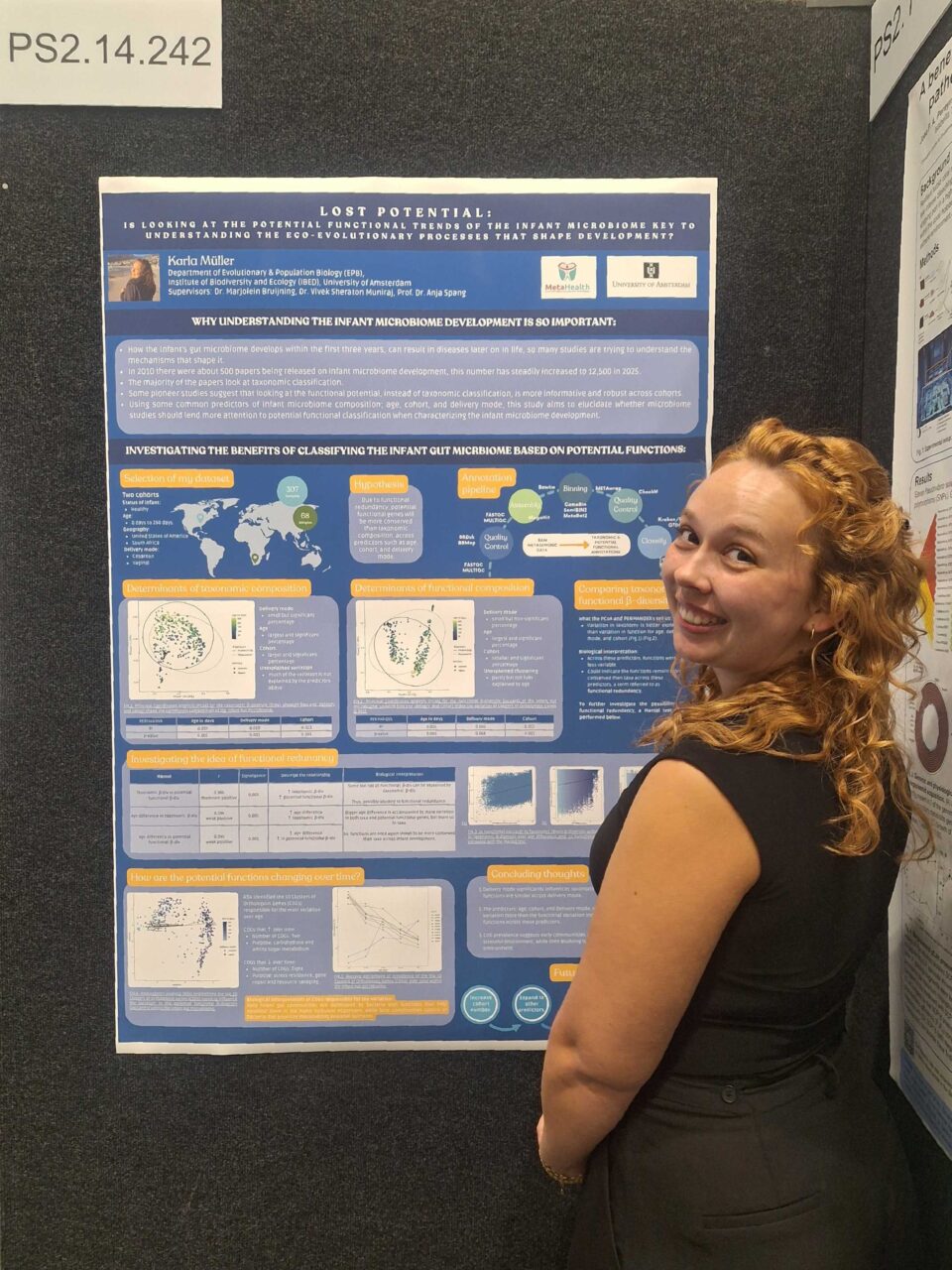
Karla in front of the poster
